Lightness with Depth from the Mosel’s Sundial
Dr. Loosen Wehlener Sonnenuhr Riesling Kabinett 2022 brings together fruit, sweetness and the energy of its slate slopes.
Dr. Loosen’s Wehlener Sonnenuhr Riesling Kabinett 2022 combines the Mosel’s classic lightness with the ripeness of a warm, dry vintage. This is a wine best approached through its balance of fruit, residual sweetness and acidity—and through the steep vineyard that gives it its name.
Drinking window: 2026–2037 · Peak: 2028–2034
- Producer
- Dr. Loosen
- Wine
- Wehlener Sonnenuhr Riesling Kabinett
- Vintage
- 2022
- Type
- Vitt vin, restsött
- Origin
- Mosel, Wehlen, Wehlener Sonnenuhr, Tyskland
- Grapes
- Riesling
- Serve at
- 8–10 °C
- Air
- No routine decanting; taste first and aerate briefly if needed.
Translated from Swedish with AI assistance. Prices converted at 10 SEK = 1 USD.
A sundial, a slope and a distinct identity
Some wines impress through weight; others build their personality on a sense of movement. Dr. Loosen Wehlener Sonnenuhr Riesling Kabinett belongs to the latter family: riesling whose fruit can feel generous, yet whose acidity and light structure keep the palate lively. The 2022 vintage also invites reflection on what lightness means in an increasingly warm Mosel. A light wine need not come from a cool summer; it does, however, require thoughtful decisions in the vineyard and at harvest.
The name reads like an address. Dr. Loosen is the producer, Wehlen the village and Sonnenuhr the vineyard site, named after the sundial on its slope. Riesling is the grape and Kabinett the wine’s Prädikat classification. That last detail matters: Kabinett denotes a category based on the ripeness of the grape must at harvest, not a fixed level of sweetness in the finished wine. Here, it is the producer’s fruity interpretation with residual sweetness, rather than a dry riesling.
For a Swedish buyer, it is wise to check the full name and vintage. Wehlener Sonnenuhr appears on wines from several growers and in several Prädikat categories. A Spätlese from the same site is not the same wine, and an offer for a later vintage tells you nothing certain about the availability of 2022. An indicative international market price is around $25, but this is not a verified Swedish retail price.
Blue slate above the Mosel
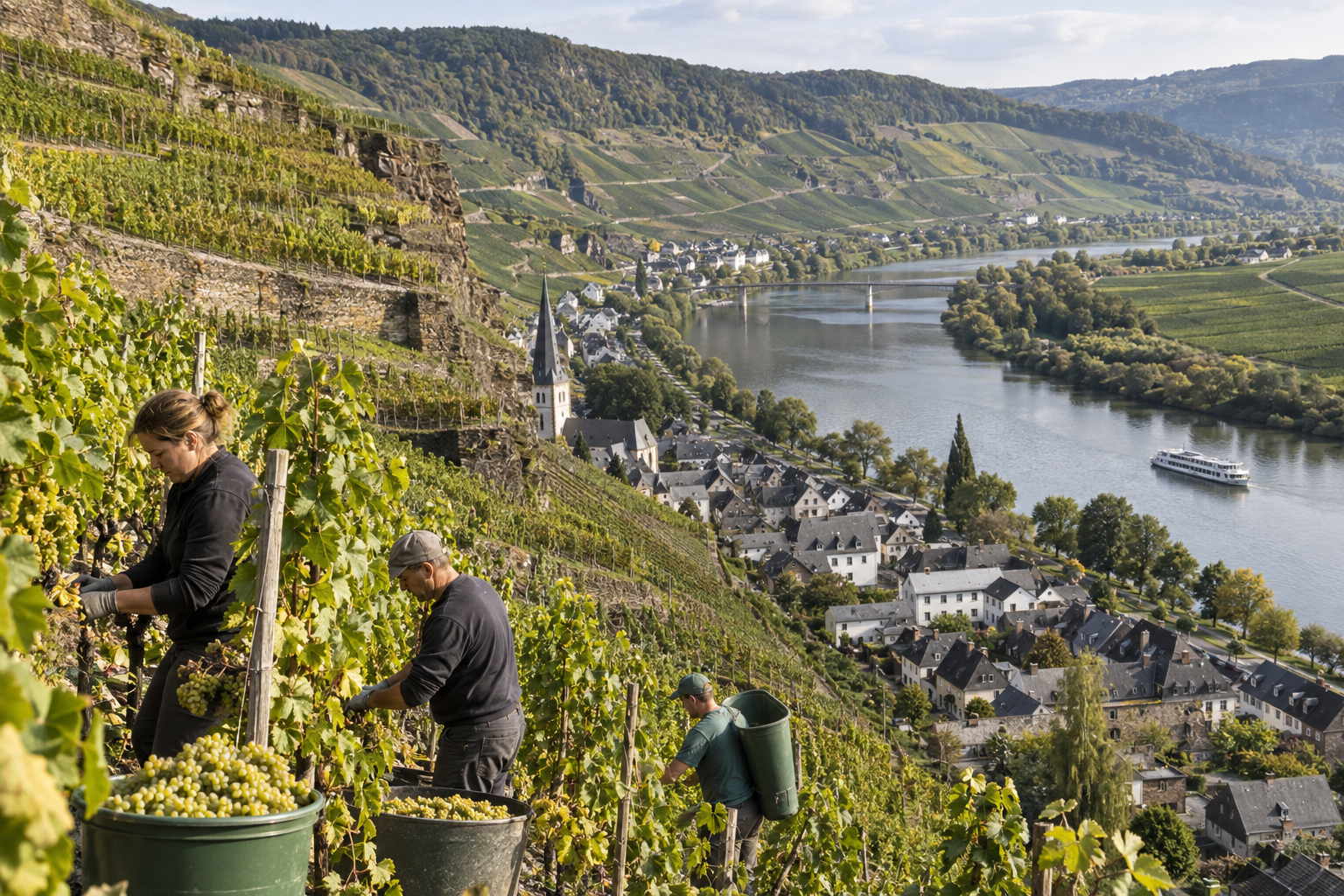
Wehlener Sonnenuhr lies beside the village of Wehlen, part of Bernkastel-Kues in the central Mosel Valley. It is one of the region’s best-known steep vineyards. The slope faces mainly south and southwest, giving it good exposure to the sun. At the same time, the Mosel is one of Germany’s northerly wine regions, where riesling’s long ripening period has traditionally allowed it to develop aromatic richness without losing all its acidity.
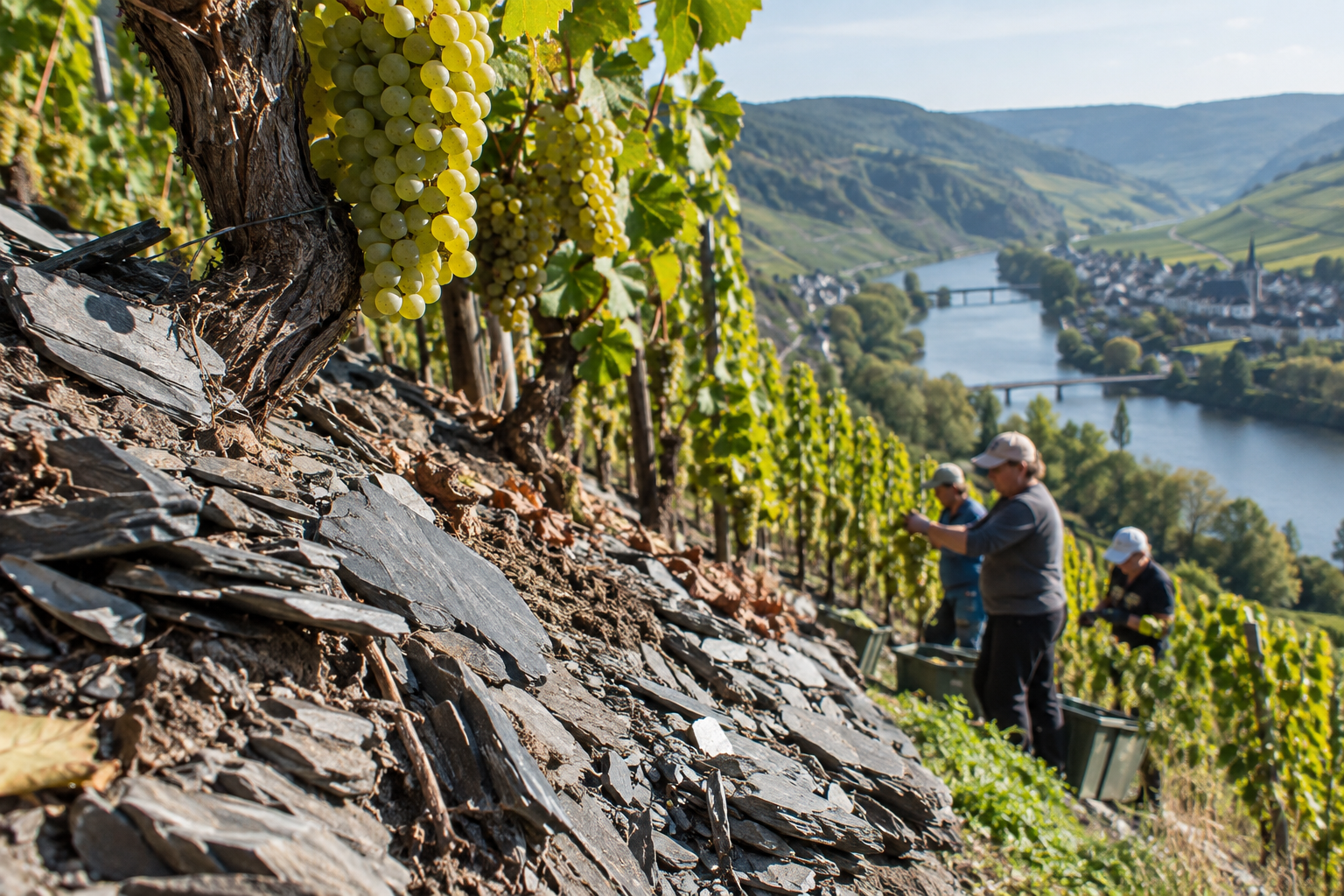
The soil is defined by blue Devonian slate: rock formed long before the valley’s present landscape took shape. Weathered slate creates a stony, well-drained growing site. On slopes like these, both soil depth and access to water matter greatly. It is therefore misleading to describe the vineyard as one uniform expanse. Differences between parcels, the age of the vines and their position on the slope can affect how the grapes cope with a dry summer.
Slate is often associated with the wine’s mineral expression. This is a useful tasting description when it refers to something stony, taut or faintly saline, but it is not evidence that the rock itself has travelled into the glass as flavour. Soil influences the wine through factors including water supply, heat conditions and vine growth. That distinction does not make the origin less interesting; it makes the explanation more sound.
The river and the valley’s sheltered sites contribute to the local climate. In a warm year, however, the task is somewhat different from that in a cool one: the grower needs to preserve freshness and prevent the grapes from losing balance. Sonnenuhr’s fame is therefore no guarantee of a particular result. The site offers possibilities, but the vintage and the work determine how they are realised.
Ernst Loosen’s work with an inheritance
The Dr. Loosen estate is based in Bernkastel and has been family-owned for more than two hundred years. Ernst Loosen took over in 1988 and made riesling that expresses its origins the clear focus of the business. He had access to something many producers would envy: old vines and holdings in several of the Mosel’s most esteemed sites. The task was to make those assets speak more clearly in the wines.
In the producer’s account of this evolution, recurring themes include lower yields, greater care for soils and grapes, and a more restrained approach in the cellar. Old vines, some of them ungrafted, are an important part of the estate’s identity. That does not mean an exact vine age should automatically be attached to every bottle. Such details must be linked to the right wine and current technical documentation.
The philosophy becomes particularly interesting in a Kabinett. Here, there is little room to hide behind high alcohol, pronounced oak or concentration. The fruit must be clearly defined, the acidity lively and the sweetness well integrated. The aim is not a thin wine, but one that holds many impressions within a light framework. It is one of the Mosel’s true specialities.
Nor should Dr. Loosen’s international reputation replace attention to the individual bottle. The producer makes many rieslings with different origins and ambitions. Wehlener Sonnenuhr Kabinett should be judged precisely as a single-vineyard wine with residual sweetness and lightness as its ideal, not as a lesser version of the estate’s most powerful dry riesling.
Riesling, fermentation and the dry year of 2022
The wine is made from riesling, a grape whose combination of aromatics and acidity is particularly well suited to this style. Grapes on the Mosel’s steep sites are usually harvested by hand, as the terrain limits the use of machinery. For a Kabinett, harvest timing is crucial: the aim is sufficient aromatic ripeness without the must becoming so concentrated that the wine’s intended lightness is lost.
Residual sweetness in this type of wine can be preserved by stopping fermentation before the yeast has converted all the grape sugar into alcohol. Cooling and filtration are common tools. The result is a different balance from that of a dry wine: the remaining sugar adds roundness, while less sugar has been turned into alcohol. Acidity provides the counterweight. Sweetness and acidity are therefore not opposites; here, they work together.
Exact details of yeast, fermentation temperature, vessels and ageing time for the 2022 are not given here, as they have not been established with sufficient certainty. Dr. Loosen uses both stainless-steel tanks and traditional wooden vessels across its range, but that is no basis for assigning a specific ageing regime to this bottling. The style is not built around an obvious new-oak character. Older, large wooden casks, when used, serve more as ageing vessels than as a source of vanilla and toasted-wood seasoning.
In 2022, German winegrowing was marked by heat and prolonged summer drought. The Mosel was also affected, but the impact varied with soils, rainfall and the condition of the vines. Rain during the harvest period changed working conditions and made selection and harvest timing important. It is therefore more accurate to describe it as a warm vintage with significant local differences than as an uncomplicated great year across the board. For Kabinett, retaining freshness was a particularly important quality consideration.
Fruit first, then energy
How, then, should the wine be understood in the glass? Without a documented tasting of a current bottle of our own, the flavour profile should be read as a description of style, based on the producer’s expression and the wine’s origins, rather than a record of exactly how your bottle smells. The expectation is pale stone fruit, apple and citrus, with floral nuances and a subtle stony note rather than oak spice.
Wehlener Sonnenuhr is often associated with elegance and nuanced fruit. In a warm vintage, that fruit may lean towards ripe peach rather than green apple alone. What matters most, though, is not which fruit you find, but how the flavour unfolds. The residual sweetness should create a soft opening, followed by acidity that brings definition and keeps the finish lively. A well-balanced Kabinett can feel both sweet and refreshing in the same sip.
Tannins play no leading role here. The structure comes primarily from acidity, sweetness and the wine’s extract—the substances that carry flavour and texture beyond water and alcohol. The finish should be judged by how long fruit and freshness linger together, not simply by intensity. With ageing, youthful citrus and floral notes can evolve into dried fruit, honeyed tones and sometimes petrol-like aromas. The latter is a familiar development in riesling, but neither a requirement nor proof of quality.
Serve cool and give the wine time
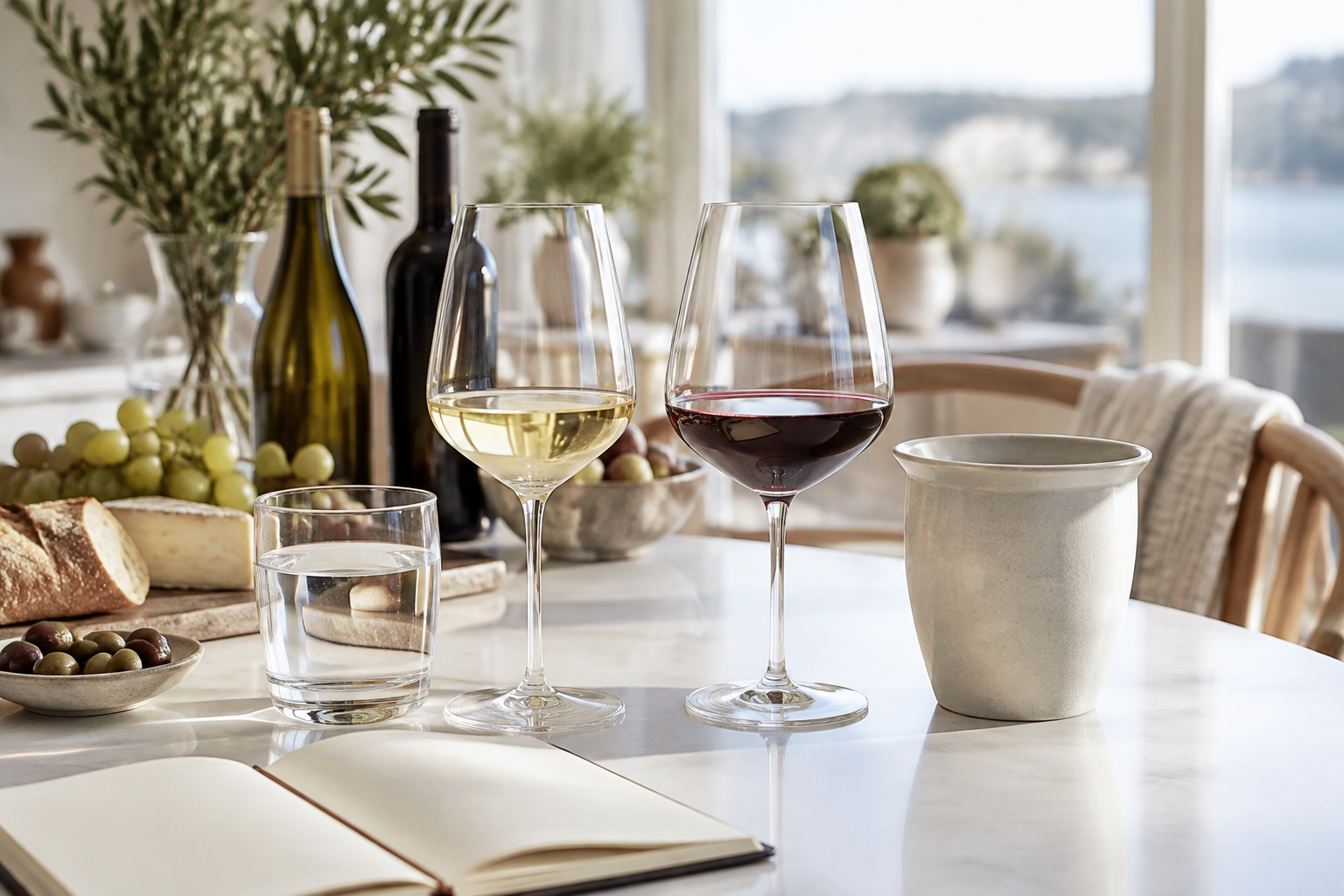
Start at 8–10 °C and let the wine gradually warm in the glass. Too low a temperature can hide its aromas and make the acidity feel harder. A medium-sized white-wine glass with a slightly tapered rim gives the aromas room without blurring the wine’s light body. Vigorous decanting is not normally necessary; taste first, and leave the bottle open briefly if the nose seems closed.
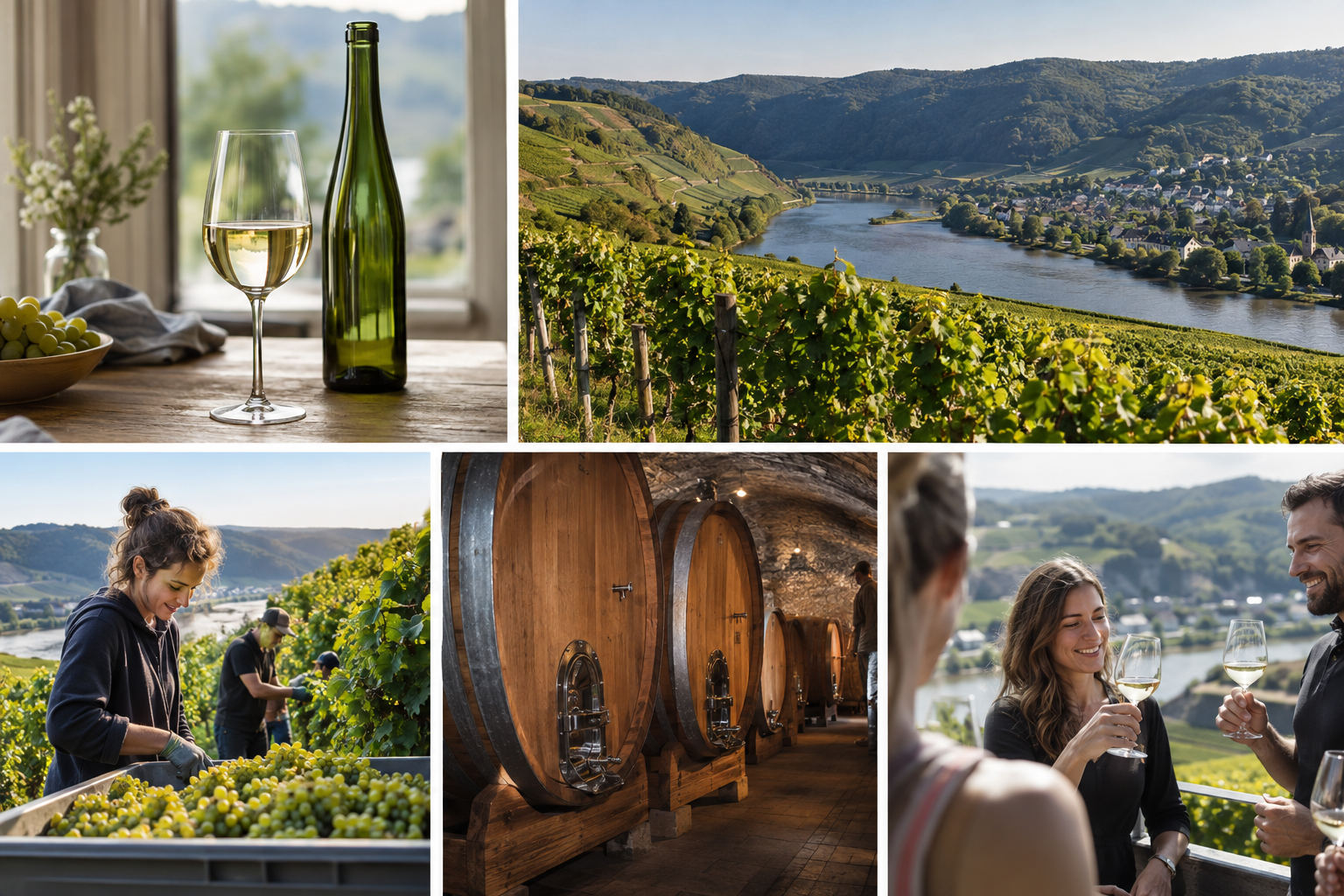
The wine can be enjoyed now, but a well-stored bottle should also have good potential to develop for several more years. Mosel Kabinett can be surprisingly long-lived, thanks to the interplay of acidity, sugar and the wine’s other components. For those who appreciate more mature aromas, a further three to ten years of cellaring is a reasonable guideline, not a guarantee. Store it somewhere dark and cool, at as steady a temperature as possible.
At the table, try a mild Thai curry with prawns, lime and coconut milk. The acidity refreshes the palate against the richness of the coconut, while the residual sweetness meets moderate chilli heat. Another fine choice is pork with apple and ginger, without an overly sweet sauce. The food need not be elaborate; above all, avoid making it so hot or sweet that the wine’s nuances disappear. An alcohol-free riesling alternative with some sweetness can play a similar role, although the balance will be different.
Tasting notes
- Pale stone fruit
- Citrus
- Floral nuances
- Residual sweetness
- Lively acidity
- Light structure
Score 92/100. The Wine’s preliminary editorial assessment, based on the reputation of the producer and vineyard, and the conditions of the vintage. No verified critic scores for this exact bottling are used; the score is not the result of a documented tasting of our own.
8–10 °C · No routine decanting; taste first and aerate briefly if needed. · Medium-sized white-wine glass with a slightly tapered rim. Indicative international market price converted to dollars; not a verified current Systembolaget price or offer for the 2022 vintage.
- Mild Thai curry with prawns, lime and coconut milkThe acidity provides freshness against the coconut milk, while the residual sweetness meets moderate chilli heat.
- Pork with apple and gingerThe apple’s fruitiness and ginger’s aromatics complement the riesling’s fruit, while the acidity balances the richness of the meat.
Sources
- Weingut Dr. Loosen, Dr. Loosen – producent, vingårdar och viner
- Loosen Bros. USA, Dr. Loosen – producentpresentation och vininformation
- Deutsches Weininstitut, Wines of Germany – vinregioner, predikat och årgångsinformation
- Moselwein e.V., Mosel – regionens vinodling och ursprung
Ask questions about "Lightness with Depth from the Mosel’s Sundial". Answers are based on the magazine's own articles.